Carrier Error Codes in West Covina
Fast answer: A Carrier error in West Covina, CA (ZIP 91790) shows up two ways - an amber flash code counted behind a furnace door, or a numeric Infinity fault like 178 or 179 on the System Control screen - so call (213) 277-6575 or book online and we read the code and quote the fix.
Quick rundown
- Carrier fault reading across 91790, 91791, 91792, 91793 and the South Hills, Galaxie, and Vincent tracts.
- Furnace status LED: count the amber flashes behind the lower door.
- Infinity / Performance: read the numbered fault on the System Control screen.
- 100-series numbers (178, 179) are communication faults on the A-B-C-D data bus.
- We carry a manometer, clamp meter, and a spare Infinity control to confirm a board call.
- Typical range: a $95 diagnostic visit up to about $2,000 for a control board (dated 2026 SoCal).
- Independent shop, not affiliated with Carrier.
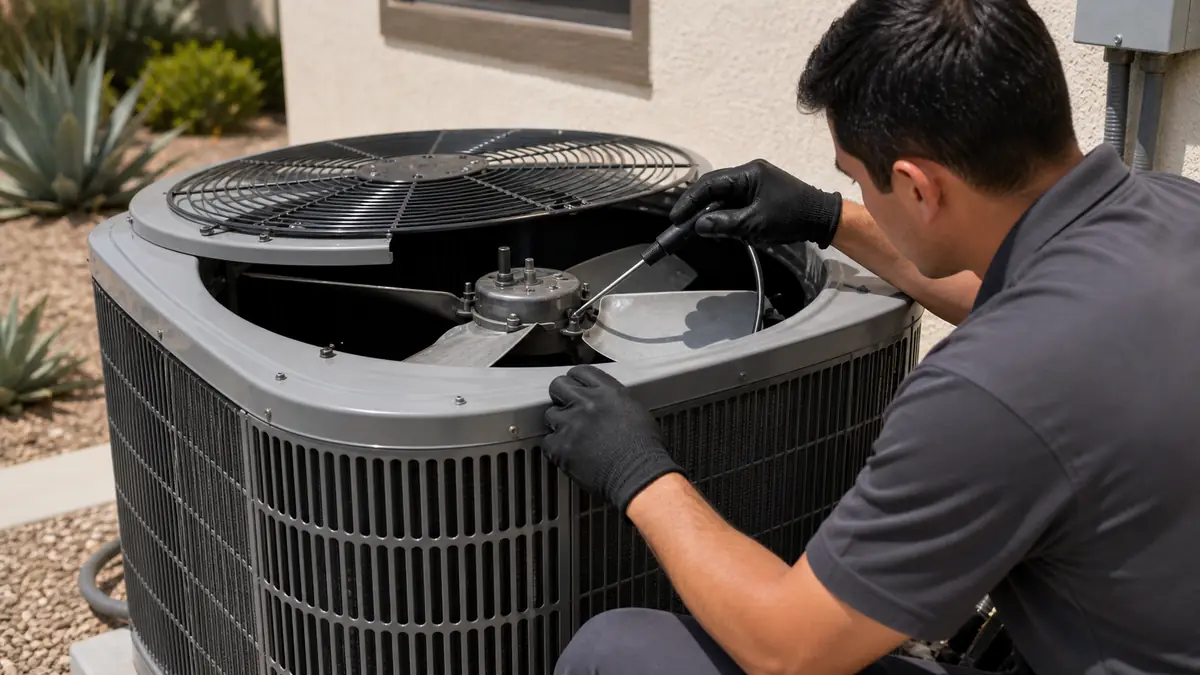
What do Carrier error codes mean on a West Covina system?
Carrier built two different fault languages, and West Covina homes run both. The post-war minimal-traditional and ranch tracts across Galaxie, Merlinda, and Vincent often have an 80 or 90 percent gas furnace that blinks a single amber status LED behind the lower access door - you count the pattern, and each count maps to a fault. The newer Spanish-style hillside estates in South Hills and the Woodside Village area lean toward communicating Carrier Infinity or Performance systems, which run a digital data bus and display a numbered fault on the Infinity System Control or wall unit. A flash code and a number code are not interchangeable; the same problem can read as a flash pattern on one box and a 100-series number on another. The table below collects the codes we pull most in the eastern San Gabriel Valley, with the first thing a tech checks for each.
| Code | Name | Meaning / first check | Cost lane |
|---|---|---|---|
| 13 | Limit-circuit lockout | High-limit tripped repeatedly from low airflow; check filter, blower, ducts | $150 - $600 |
| 31 | Pressure-switch / draft fault | Inducer not proving draft; check flue, inducer, sensing tube, condensate trap | $150 - $700 |
| 33 | Limit-circuit fault | Heat exchanger ran too hot from low airflow; check filter and blower | $150 - $600 |
| 34 | Ignition proving failure | Flame sensed then lost; clean or replace the flame sensor, check gas | $150 - $350 |
| 178 | Indoor communication fault | Thermostat lost the indoor board over A-B-C-D wiring | wiring to $2,000 |
| 179 | Outdoor communication fault | Control lost the outdoor unit; comm wiring or low line voltage | wiring to $2,000 |
Two of these - the communication faults 178 and 179 - get their own deep walkthroughs because they trip up the most homeowners and the most parts-cannon repairs. Read the Carrier 178 indoor communication fault page and the Carrier 179 outdoor communication fault page for the full diagnostic on each.
How do you read codes on a Carrier system?
On a furnace, we kill power at the switch, pull the lower door, and watch the control board's status LED through a viewing window or off the board directly. A steady or slow on-off pattern is normal standby; a repeating burst - say three quick amber flashes, then a pause, then three more - is the fault. We count it twice to be sure, then cross it to the legend printed on the inside of the blower door, because Carrier and Bryant share boards and the legend is model-specific. On an Infinity or Performance system the work is different: we open the System Control's service menu, read the active and stored faults in plain numbers, and note the timestamp. The numbers matter - a 100-series fault (110 through the 180s) is almost always a communication or power problem on the four-wire A-B-C-D bus, not a mechanical part. Reading the right language first keeps us from condemning a $1,400 board when a corroded wire nut in a South Hills attic junction is the real culprit.
Why do these codes show up in West Covina homes?
Climate and housing stock drive the pattern. West Covina sits in Title-24 Climate Zone 9 in the eastern San Gabriel Valley, edging toward the Inland Empire, so summers are hot and dry and a Carrier condenser runs hard from late spring into fall. That heat load surfaces airflow and limit faults (codes 13 and 33) when a filter clogs with valley dust, and it stresses outdoor electronics that throw communication faults like 179. The older tract homes were not wired for communicating equipment, so when an Infinity system gets retrofitted into a 1960s Galaxie ranch, the long, spliced low-voltage runs through a 130 F attic are exactly where the A-B-C-D bus develops the intermittent breaks behind a 178. Winter pressure-switch faults (code 31) cluster in the cooler, damper weeks when a flue or condensate trap on a 90 percent furnace gets marginal. The codes are not random - they track this city's mix of dust, heat, attic temperatures, and retrofitted controls.
How do you fix Carrier codes, and what does it cost?
We fix to the root cause the code points at, not to the code itself. Airflow and limit faults (13, 33) start with the cheapest real fix - a correct filter and a static-pressure reading - and only escalate to a blower or limit switch if the numbers demand it, landing roughly $150 to $600. Draft faults (31) get a manometer on the pressure switch and an inspection of the inducer, flue, and condensate trap; an inducer runs about $300 to $700, a pressure switch $150 to $350, and a plugged trap clears within the visit. Ignition-proving faults (34) usually end at a cleaned or replaced flame sensor, $150 to $350, before we touch the gas valve. The communication faults 178 and 179 start at the wiring - terminations, splices, and line voltage - which often resolves within a $95 to $200 visit; only a confirmed board failure reaches the $400 to $2,000 range. We measure before we replace, so you are not buying a board to chase a wire. Prices are dated 2026 Southern California ranges, not quotes.
When is a Carrier code urgent versus wait-a-day?
Anything that touches combustion or keeps locking out is same-day. A furnace that flashes a pressure-switch (31) or limit (13, 33) fault and refuses to fire on a cold West Covina morning should not be force-reset repeatedly, because the safety it tripped is protecting against overheating or bad venting. An Infinity board that drops communication mid-cycle (178 or 179) during a 95 F afternoon leaves a home with no cooling, which matters fast for older residents in the inland heat. Soft sensor faults that clear and let the system run can usually wait for a scheduled visit. If you ever smell gas, leave the gas valve off and call from outside the house. For everything else, note the exact code, then call (213) 277-6575 or book online and we will triage it by number before we roll a truck.
Common questions
Where does my Carrier system show its error code?
On an 80/90-series Carrier furnace, the code appears as a blinking amber LED behind the lower door - count the flash pattern, like three flashes for a pressure-switch fault. On an Infinity or Performance communicating system, the Infinity System Control or the wall thermostat shows a numeric fault such as 178 or 179 in plain text under its service or fault menu, no counting needed.
Are Carrier furnace flash codes and Infinity number codes the same thing?
No, and mixing them up sends people chasing the wrong part. Older single-stage Carrier furnaces blink a status LED you count by hand. Infinity and Performance communicating systems run a digital A-B-C-D data bus and report numbered faults (the 100-series like 178 and 179 are communication faults) on a screen. The diagnostic path is different for each, so always note which kind of equipment you have before you start.
Can I clear a Carrier code by cutting the power?
Cycling power at the breaker clears a soft lockout and the system may restart, but that only resets the count - it does not fix the cause. If the same code returns within a cycle or two, the underlying fault (a draft problem, a flame-sense issue, a broken comm wire) is still there. Repeated hard resets on a gas furnace can also mask a real combustion-safety problem, so note the code before you reset and call if it comes back.
Which Carrier codes are urgent in West Covina?
Treat anything touching combustion or repeated lockouts as urgent: a furnace flashing a pressure-switch or limit fault in winter, or an Infinity board that keeps dropping communication mid-cycle in a 95 F summer. Soft sensor faults can wait a day. If you smell gas, shut the gas off and call from outside. Phone (213) 277-6575 and we triage by code over the phone.