Carrier Heat Pump Repair in West Covina
Fast answer: West Covina Carrier HVAC repairs Carrier heat pumps across West Covina and South Hills (91791) - reversing valves, defrost boards, capacitors, inverter faults, and Infinity 178/179 communication errors on 27-series units. A diagnostic runs $95-$200 and reads the fault code first, so call (213) 277-6575 or book online.
Quick rundown
- Carrier heat-pump repair across 91790, 91791, 91792, 91793.
- Lines serviced: Infinity 27VNA3/27VNA1/27VNA0 Greenspeed, Performance 27VPA9/27TPA8, Comfort 27SCA5.
- Common parts: reversing valve, defrost board, capacitor, contactor, condenser fan motor, inverter PCB.
- Typical repair range: $150 to $2,000; compressor jobs reach $3,500 out of warranty.
- Diagnostic-first: $95-$200, often credited toward an approved repair.
- In-warranty Carrier heat pumps referred to a factory-authorized dealer first.
- Independent shop.
What goes wrong with Carrier heat pumps in West Covina?
In Climate Zone 9, the eastern San Gabriel Valley heat does most of the damage in cooling mode. Carrier heat pumps run hard from May through September, and the first casualties are the dual-run capacitor and the contactor - cheap parts whose failure leaves the condenser humming with a dead fan. Next most common is low refrigerant from a flare or coil leak, which shows as long run times, weak output, and ice on the outdoor coil. On communicating Infinity units the touchscreen will often log code 44 (air-delivery restriction) when a dirty filter or collapsed return in a Galaxie tract home starves airflow.
Heating-mode complaints are seasonal but real here: a stuck reversing valve or a failing defrost board makes a 27VNA pump blow cold air or ice over on a cool Merlinda morning. We confirm the valve solenoid, the defrost sensor, and the OAT/OCT thermistors (codes 54 and 56) before touching the refrigerant circuit.
| Symptom | Likely cause / first check | Cost lane |
|---|---|---|
| No heat, fan runs, cold air in heat mode | Stuck reversing valve / solenoid or defrost board | $250 - $900 |
| Outdoor unit hums, won't start | Failed dual-run capacitor or pitted contactor | $150 - $450 |
| Frost stays on outdoor coil | Defrost sensor or board; check OAT/OCT thermistor (codes 54/56) | $200 - $700 |
| Touchscreen shows 178 / 179 | ABCD communication wiring or water-damaged control board | $400 - $2,000 |
| Weak output, long run times, ice on coil | Low refrigerant at a flare/coil leak; Infinity may log 44 | $225 - $1,500 |
| Greenspeed unit runs single-speed only | Missing/failed Infinity System Control or inverter board | $400 - $2,000 |
How does a Carrier heat-pump repair actually go?
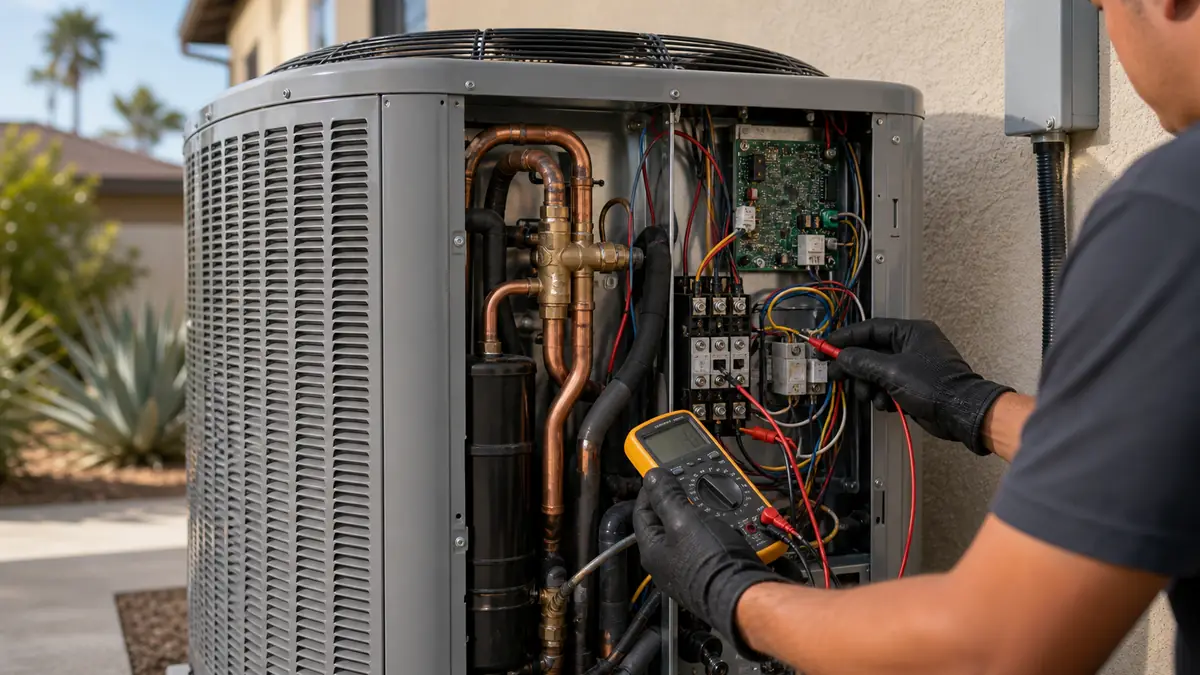
On a heat pump the order of checks matters even more than on a straight AC, because the unit has a heating side and a defrost cycle to rule out, so we hold to a set route through it rather than chasing the first thing that looks wrong. We start by reading the system state - the numeric and plain-language code on the Infinity touchscreen, or the behavior of a non-communicating Performance or Comfort unit - and confirm the symptom you reported. Then comes the electrical pass: we meter the dual-run capacitor against its nameplate microfarads, inspect the contactor for pitted or welded points, and confirm line voltage and the 24V control circuit at the condenser. If the electricals are clean, we move to the sealed system, putting gauges on the service ports to read subcooling and superheat, which separates a refrigerant leak from a defrost or airflow problem. In heating mode we energize the reversing-valve solenoid and watch the changeover, and we confirm the defrost board and OAT/OCT thermistors (codes 54 and 56). Only then do we name the failed part, pull it from the truck stock when possible, install it, and verify the repair by re-reading temperatures, pressures, and the cleared fault code before we leave.
Which Carrier heat-pump lines do you repair?
We service the full 27-series across all three tiers. The Comfort 27SCA5 is a single-stage value pump - electrically simple, so its faults are the classic capacitor, contactor, and fan-motor failures with no communicating board to read. The Performance tier covers the single-stage 27SPA6, the two-stage 27TPA8 (Performance 18), and the variable-speed 27VPA9 (Performance 19, InteliSense), where staging and the thermostat wiring matter to the diagnosis. The Infinity Greenspeed pumps - 27VNA0 (Infinity 20), 27VNA3 (Infinity 23, the most efficient Carrier makes), and the cold-climate 27VNA1 - plus the legacy 24VNA/25VNA Greenspeed families add an inverter PCB and the Infinity System Control on the ABCD bus, so their distinctive faults are electronic and communication-based rather than purely mechanical. Knowing which line is on the pad tells us before we open a panel whether we are chasing a relay or a comm bus.
How do you diagnose an Infinity Greenspeed fault?
Greenspeed pumps (24VNA/25VNA legacy and current 27VNA) only modulate when paired with an Infinity System Control over the ABCD communication bus. If yours runs single-speed or throws 178/179, we start at the four-wire bus and connections, not the inverter board - corrosion and water intrusion at the low-voltage terminals are far more common than a failed PCB, and a board swap is a $400-$2,000 mistake if the wiring was the real fault. We read the plain-language code, check line voltage at the condenser, and meter the inverter only after the bus checks out.
What does a heat-pump repair cost in West Covina?
Repairs break into clear lanes. The diagnostic is $95-$200 and reads the code first; it is often credited toward an approved repair. The wear-item fixes - a dual-run capacitor or a contactor - sit at $150-$450, mostly labor and trip since the part itself is cheap. A defrost or reversing-valve repair runs $250-$900 depending on whether the valve body or just its solenoid is at fault. A refrigerant leak repair plus recharge is $225-$1,500, with R-410A running roughly $50-$80 per pound installed and the high end reflecting a coil or flare repair. The electronic faults are the costliest: an out-of-warranty inverter or communicating board is $400-$2,000, and a compressor on a Greenspeed unit reaches $1,200-$3,500 - the point at which we usually put a replacement number next to the repair number so you can choose with both in hand. Carrier heat pumps still inside their parts warranty should go to a factory-authorized dealer first, and we will tell you when that applies.
When does a heat-pump repair become a replacement?
When your 27-series pump needs a compressor and it is already past 10-12 years, a repair bill that reaches about half the price of a new system is the line where we stop recommending the fix and start pricing a replacement. The exception runs the other way: a failing inverter board on a newer South Hills estate pump is usually well worth repairing. We set out both paths and the rebate caveats in the repair-or-replace guide; if you choose to upgrade, see heat-pump installation and the Carrier heat-pump lineup.
Common questions
Why does my Carrier heat pump blow cold air in heating mode?
Usually a stuck reversing valve or its solenoid, or the system parked in a defrost cycle. On an Infinity 27VNA unit we check the valve, the defrost board, and the outdoor coil thermistor (codes 54/56). A South Hills estate with a long heating call and frost buildup often just needs a defrost-sensor or valve repair, not a new compressor.
Is it worth repairing a 12-year-old Carrier heat pump in West Covina?
When the fix is a capacitor, contactor, or sensor under roughly $600, yes. When it calls for a compressor (about $1,200-$3,500 out of warranty) on a unit already past 10-12 years in our Zone 9 heat, replacement generally wins out. You get both numbers in hand before you decide.
What does 178 or 179 mean on my Infinity touchscreen?
Code 178 is an indoor-unit communication fault and 179 is an outdoor-unit fault - almost always damaged or loose ABCD communication wiring, a water-damaged control board, or lost line voltage to the condenser. We trace the four-wire bus before condemning any board.
What does code 73 mean on a Carrier heat pump?
Code 73 means voltage was sensed at the run capacitor with no call for the compressor - it points at the contactor, a stuck relay, or a wiring fault on 24ANA/25HNA-style outdoor families, not a dead compressor. We check the contactor and the low-voltage control path before assuming the worst, since that turns a $150-$450 fix into a needless quote.
My heat pump's outdoor fan spins but it won't cool. What is wrong?
If the fan runs but the compressor stays silent or hums, the usual cause is a failed dual-run capacitor or a pitted contactor - the top West Covina summer failures. A diagnostic meters the capacitor against its rated microfarads and inspects the contactor points; both are typically a same-visit fix in the $150-$450 lane once confirmed.
Does a heat pump repair need a permit in West Covina?
A like-for-like repair - capacitor, contactor, board, sensor, or a sealed-system leak fix - does not need a permit. Permitting and Title-24 charge and airflow verification come into play when a repair crosses into a system replacement, which we flag clearly before any work that would trigger it.