Carrier 179 Code in West Covina
Fast answer: A Carrier 179 in West Covina, CA (ZIP 91792) is an outdoor communication fault, meaning the Infinity control lost the condenser over the A-B-C-D bus - often from sun-cracked wiring or low line voltage on a hot side yard - so call (213) 277-6575 or book online and we test it on site.
Quick rundown
- Carrier 179 = outdoor-unit communication fault on the Infinity A-B-C-D data bus.
- Direction is the tell: 179 is the outdoor side, 178 is the indoor side.
- West Covina suspects: sun-cracked comm cable, loose condenser terminal, sagging line voltage.
- We read incoming voltage at the outdoor unit under load before touching a board.
- Wiring/voltage fix: often within a $95 to $200 visit. Outdoor board: $400 to $2,000.
- Service across 91790, 91791, 91792, 91793 in the eastern San Gabriel Valley.
- Independent shop, not affiliated with Carrier.
What does a 179 code mean on a Carrier Infinity system?
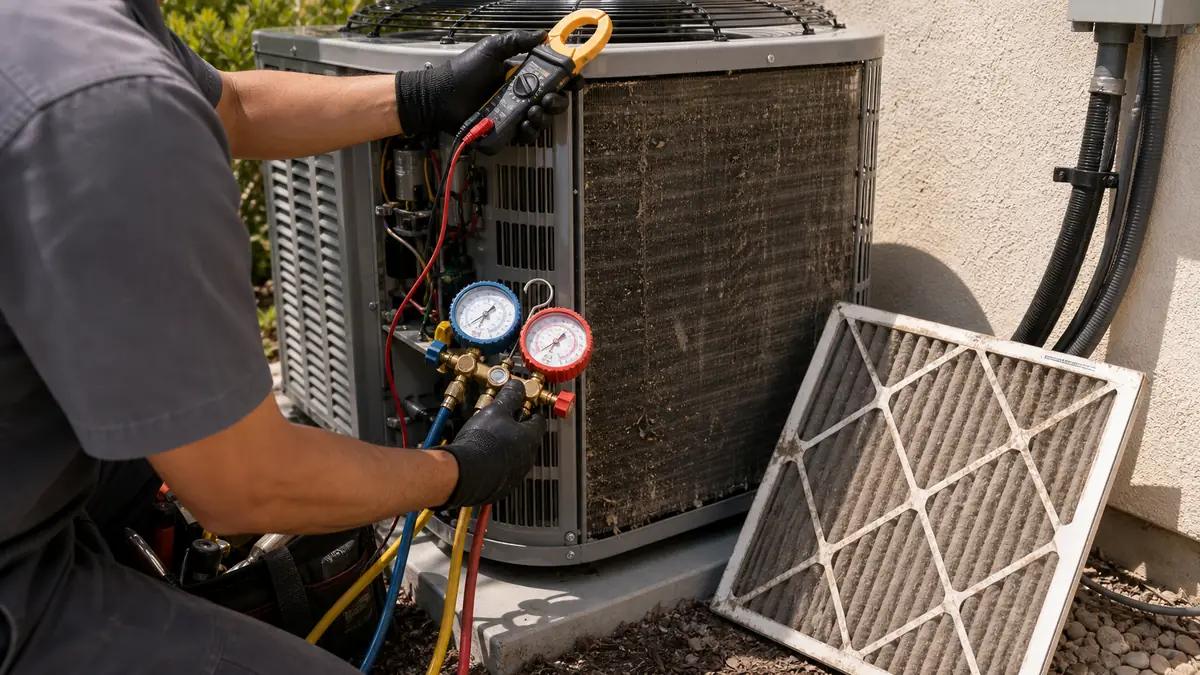
On a communicating Carrier Infinity or Performance system, the indoor unit, outdoor unit, and thermostat all share one four-wire data bus - A, B, C, and D. The system runs in constant conversation, with the System Control coordinating staging across all three. Code 179 means that conversation went one-sided in a specific direction: the control can no longer hear the outdoor condenser or heat pump. Where a 178 points indoors, a 179 points outdoors. The link to the condenser is broken, and the system cannot run cooling - or, on a heat pump, cannot run outdoor-driven heating - without it. The break is usually physical or electrical on the outdoor side: a comm conductor damaged on the run to the condenser, a connection loosened at the outdoor board, or the outdoor unit's incoming line voltage sagging low enough that its board browns out and stops talking. A genuinely failed outdoor or inverter board is the least common cause, and it is the last thing we conclude, not the first.
Why do West Covina condensers throw a 179?
The outdoor environment in the eastern San Gabriel Valley is hard on the things that cause a 179. Condensers here sit through long, hot, dry summers, often on a south- or west-facing side yard in a South Hills or Vincent home where afternoon sun bakes the line set and the low-voltage cable beside it. UV and heat embrittle cable insulation over years until a conductor cracks or shorts, and that shows up as an intermittent 179 that worsens through the cooling season. The second West Covina driver is voltage. A condenser fed by a long, older, or undersized line-voltage run can see its supply sag under peak summer load - and during a Zone 9 heat wave, when the whole grid is leaning hard, marginal voltage at the outdoor unit can drop the board below where it can communicate, posting a 179 in the heat of the afternoon and clearing by evening. Retrofitted Infinity systems in 1960s tract homes add the same long-attic-and-wall splice risk that plagues their indoor 178 cousins. Heat, sun, distance, and an old electrical service are the local recipe.
How do you diagnose a Carrier 179, and what are the suspects?
We start at the condenser, because a 179 names the outdoor side and because that is where the two extra suspects - line voltage and the disconnect - live. The sequence: pull the fault history off the System Control to see whether the 179 is hard or intermittent and what time it drops; kill power and inspect the A-B-C-D cable along the entire outdoor run for sun cracking, chew marks, and pinch points; check the terminals at the outdoor board for loose or corroded leads; then, critically, restore power and read the incoming line voltage at the disconnect and at the outdoor board under load, watching for sag. Only when the wiring is clean, the terminals are tight, and the voltage holds do we meter or swap-test the outdoor control. The table sorts the suspects by how often they are the answer in West Covina.
| Cause | What we find | Cost lane |
|---|---|---|
| Comm wiring damaged on the run to the condenser | Sun-baked, cracked, or rodent-chewed A-B-C-D cable on the outdoor run | Within a $95 - $200 visit |
| Loose or corroded terminal at the outdoor board | Vibration and weather back out a connection at the condenser | Within a visit |
| Low line voltage feeding the outdoor unit | Long/undersized run sags under summer load on a hot side yard | Wiring/voltage correction |
| Tripped or weak outdoor disconnect | Pulled fuse, loose lug, or scorched disconnect at the condenser | $95 - $350 |
| Failed outdoor / inverter control board | Confirmed only after wiring and voltage check clean | $400 - $2,000 |
What can a homeowner safely check first?
There are a couple of safe, useful checks before you call. Look at the outdoor disconnect box next to the condenser: if the pull-out is fully seated and you see no scorching, buzzing, or melted plastic, that is good information to relay. Glance at the low-voltage cable where it runs into the condenser for an obviously chewed, hanging, or sun-shredded section. And confirm the indoor side still has power and a lit Infinity screen, which helps us tell a 179 from a wider power problem. That is the safe limit. Do not pull the disconnect and probe inside it, do not re-land the A-B-C-D wires at the outdoor board, and do not keep cycling the breaker to force the unit to run - line voltage at the condenser is dangerous, and a miswired bus can take out an outdoor board. If the disconnect is hot to the touch, buzzing, or scorched, leave it alone and treat it as urgent. Note the exact code and whether it comes and goes with the afternoon heat, because an intermittent, heat-driven 179 points us straight at voltage or sun-damaged cable.
What does a 179 cost to fix, and when is it urgent?
The fix tracks the suspect we confirm. A damaged comm cable, a loose or corroded outdoor terminal, or a tightened connection usually resolves within a $95 to $200 diagnostic visit. A line-voltage problem - a sagging or miswired run, a weak disconnect - is corrected at the source and lands in a similar-to-modest range, roughly $95 to $350 for disconnect work, more if a circuit needs real attention. A genuinely failed outdoor or inverter control board, confirmed only after the wiring and voltage check out, runs about $400 to $2,000 for the part and labor. Because we read voltage and inspect the run before condemning the board, you are not paying for an expensive part to fix a cracked wire. On urgency: a 179 strands cooling and, on a heat pump, outdoor heating, so during an inland West Covina heat wave it is a same-day call - the Zone 9 afternoons that trigger it are the same afternoons a home most needs the AC. A scorched or buzzing disconnect is an immediate call regardless of weather. Otherwise, note the code and book promptly, since a sun-damaged cable only degrades further. Call (213) 277-6575 or book online and we will confirm it is the outdoor-side 179, not the indoor 178, and test it on site.
Common questions
What does Carrier code 179 mean?
Code 179 is an outdoor-unit communication fault on a Carrier Infinity system: the System Control has lost its data link to the outdoor condenser or heat pump over the A-B-C-D bus. The usual causes are damaged comm wiring on the run to the condenser, a loose terminal at the outdoor board, or low line voltage feeding the outdoor unit - and only sometimes a failed outdoor or inverter board.
How is a 179 different from a 178?
Direction. A 178 means the control cannot reach the indoor furnace or air handler; a 179 means it cannot reach the outdoor condenser or heat pump. They are the same kind of A-B-C-D communication failure on opposite ends of the system. A 179 also adds a suspect a 178 does not - the line-voltage power feeding the outdoor unit - so we always check the condenser's incoming voltage on a 179.
Can low voltage cause a Carrier 179 in West Covina?
Yes, and it is a real West Covina pattern. A long, undersized, or aging line-voltage run to a condenser placed on a hot South Hills side yard can sag under summer load, and during a Zone 9 heat wave when the grid is stressed, marginal voltage at the outdoor unit can drop the communication and post a 179. We read incoming voltage under load before condemning any board.
Is a Carrier 179 dangerous or just inconvenient?
By itself a 179 is not a gas-safety hazard - it is the outdoor side, so it mainly kills cooling (and heat-pump heating). The risk is comfort and timing: it usually strands a West Covina home with no AC, which matters in an inland heat wave. If the outdoor disconnect is hot, buzzing, or scorched, treat that as urgent and call. Otherwise note the code and book it promptly.