Repair or Replace Your AC in West Covina
Fast answer: Repair your West Covina Carrier AC while it is under roughly 10 years old and the fault is small; replace it once a major part on a 10-to-14-year-old unit tops half a new system. Call (213) 277-6575 or book online and West Covina Carrier HVAC works the numbers across 91790 to 91793. Last updated 2026-06-13.
Quick rundown
- First test: when the repair tops ~50 percent of a new system AND the unit is 10-12+ years, replace.
- Second test: when age times repair cost passes ~$5,000, lean replace.
- Minor parts (capacitor, contactor) are almost always worth repairing at any age.
- R-410A phase-down makes large recharges on leaky old units a declining value.
- Zone 9 runs cooling 5-6 months a year, so efficiency gains pay back faster here.
- A cracked heat exchanger is a safety replace, not a repair.
- Replacement range: $5,000 to $16,500 (dated 2026 SoCal).
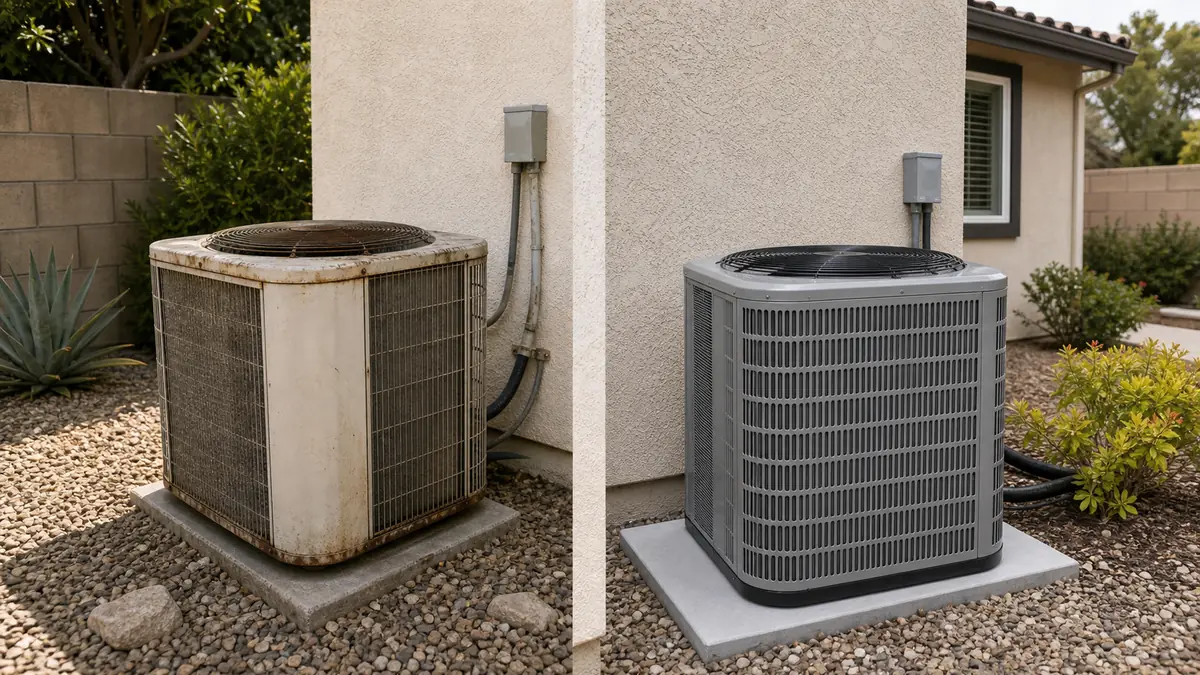
What is the simple rule for repair versus replace?
Two rules of thumb settle most West Covina calls. The first looks at proportion: once the repair quote runs past about half the cost of a comparable new system and the unit is already beyond 10-12 years, replacement is the wiser outlay. The second works as a quick sanity check - take the unit's age and multiply it by the repair cost, and if the product crosses roughly $5,000, lean toward replacing. By that math a 13-year-old condenser facing a $1,200 compressor lands near $15,600, an obvious replace; a 6-year-old unit needing a $300 capacitor lands at $1,800, an obvious repair. Neither rule is the final word, but paired together they keep you from pouring real money into a system that is nearly done.
| Age and repair | Repair cost | Lean toward | Why |
|---|---|---|---|
| Under 8 yr, minor part (cap/contactor) | $150 - $450 | Repair | Cheap fix, plenty of life left |
| 8-12 yr, mid repair (motor/board) | $450 - $2,000 | Usually repair | Weigh against age and history |
| 10-14 yr, major part (compressor/coil) | $1,200 - $3,500 | Usually replace | Repair nears half of new system |
| 14+ yr, any major repair | $1,200+ | Replace | Efficiency and reliability favor new |
| Cracked heat exchanger (furnace) | $300 - $2,000 | Replace (safety) | CO risk; replacement is safer |
How does West Covina's climate change the math?
Climate Zone 9 tilts the scale toward replacement sooner than a mild coastal town would. With 92-96 F July highs and 55-75 days a year above 90 F, a West Covina system runs hard for half the year, so two things happen: aging units wear faster, and the efficiency gap between an old 10-12 SEER condenser and a modern 14.3+ SEER2 unit translates into a larger dollar difference on the SCE bill than it would in a short cooling season. That is why a borderline repair on a tired unit often loses here - you are paying to keep an inefficient machine running through the exact months it costs the most to run. For the 1960s Galaxie and Vincent tracts, that frequently means a like-for-like replacement is the smarter long-term move; for South Hills estates, a variable-speed upgrade.
What does the R-410A phase-down mean for my decision?
Most current West Covina systems use R-410A refrigerant, which is being phased down under federal rules. Practically, that means R-410A gets more expensive over time, so a big recharge on a system that keeps leaking is a worse value each year. A single, locatable leak at a flare or service valve is a reasonable repair. But a major evaporator-coil leak on a 12-year-old R-410A unit is a strong replacement signal - you would pay for an expensive recharge on refrigerant whose cost is climbing, in a system that is already aging. New equipment also moves toward lower-GWP refrigerants, which future-proofs the purchase. Refrigerant leak repairs themselves run roughly $225-$1,500 depending on the source; we always quote the repair against the replacement so you see both.
Three worked West Covina examples
The rules are easiest to trust when you watch them run on real units. Example one: a 6-year-old Carrier 26SPA6 in a Woodside Village home loses cooling on a 96 F afternoon, and the diagnosis is a failed dual-run capacitor. Age times cost is 6 times $300, about $1,800 - well under the $5,000 line - and the unit has years left. Clear repair, usually same visit.
Example two: a 13-year-old Comfort condenser in Galaxie ices its evaporator and the leak is a corroded indoor coil; the repair quote is $1,800 once you add the coil, recharge, and labor. Age times cost is 13 times $1,800, about $23,400, and the repair already nears half a new $7,000 to $9,000 system on aging R-410A. That is a textbook replace. Example three sits in the gray zone: an 11-year-old Performance unit needs a $900 ECM blower motor. Age times cost is roughly $9,900, just over the line, so we weigh the unit's history - if the coil and compressor are healthy and it has been reliable, repairing buys a few more years; if it has a record of failures, we lean replace. The math frames the call; the unit's history breaks the tie.
How do parts warranties change the repair math?
Before condemning a unit, we check the Carrier warranty clock, because it can flip a borderline decision. Carrier registered systems commonly carry a 10-year parts warranty on the compressor and major components to the original owner. On a 9-year-old unit that means a compressor failure may cost only labor - roughly $600 to $1,200 - rather than the full $1,200 to $3,500, which can make a repair sensible where it otherwise would not be. The catch is that warranty covers the part, not the labor or refrigerant, and it usually requires the system to have been registered within the original window. We read the serial-number date and registration status off the data plate so the repair-or-replace number you see reflects what you would actually pay, not the sticker cost of the part.
When is replacement the only safe choice?
Some failures are not a money decision. A cracked or rollout-tripping heat exchanger on a gas furnace (Carrier code 26) is a carbon-monoxide risk, and replacing the furnace is safer and usually cheaper than the exchanger alone - often the moment to consider a heat-pump conversion. A compressor that has burned out and contaminated the refrigerant circuit, or repeated electrical failures on a unit with a history, also point to replacement. We will tell you plainly when a repair is throwing good money after bad.
How does the R-454B transition factor in?
There is a second refrigerant wrinkle beyond the R-410A phase-down. New equipment is moving to lower-GWP refrigerants - Carrier and the rest of the industry are shifting current production toward A2L refrigerants such as R-454B - which means a system you buy today is built around the refrigerant the field will stock for years to come, while R-410A becomes the legacy product whose price drifts up. Practically, that strengthens the replacement case on an old, leaky R-410A unit: you would be sinking money into a large recharge of an increasingly expensive refrigerant in a system that is already near the end of its service life. It does not mean you must replace a healthy R-410A system - a sound unit with a small, fixable leak is fine to keep. It does mean that when a major sealed-system repair lands on an aging R-410A condenser, the refrigerant trend is one more weight on the replace side of the scale, alongside age, efficiency, and the repair-to-new-system ratio.
How do I decide with confidence?
Start with a real diagnosis: the fault code, the failed part, and the unit's age and history. We give you the repair number and a like-for-like replacement number side by side, with the efficiency savings estimated against your usage. From there, the buying guide helps pick a tier and the sizing guide ensures the new unit is right-sized. For the underlying symptoms, see high bills, weak airflow, or book a diagnostic visit.
Common questions
At what age should I stop repairing my West Covina AC?
No single number ends it, yet once a unit clears 10-12 years the numbers generally favor replacement, particularly for a big-ticket part. Fixing a capacitor on a 12-year-old condenser still makes sense; sinking money into a compressor or coil on that same unit rarely does, since you would lay out half the price of a new, much more efficient system to keep an old one alive.
My Carrier unit uses R-410A - does that force a replacement?
No, but it is a factor. R-410A is being phased down, so its price trends upward over time, which makes a large recharge on a leaky old system a worse value each year. A small, fixable leak is fine to repair; a major coil leak on an aging R-410A unit pushes the decision toward a new system on current refrigerant.
Will a new system really lower my SCE bill in West Covina?
Often meaningfully. West Covina runs cooling 5-6 months a year, so replacing a 10-12 SEER unit from the 2000s with a 14.3+ SEER2 system, or a variable-speed Greenspeed unit, cuts the energy used for the same comfort. We estimate the savings against your actual usage so the payback is realistic, not a sales number.
Is it worth repairing a compressor on a 9-year-old Carrier unit?
Sometimes yes, because of warranty. Carrier compressors often carry a 10-year parts warranty to the original registered owner, so on a 9-year-old unit you may pay only labor (roughly $600 to $1,200) instead of the full $1,200 to $3,500. We check the warranty status and serial-number date first; an in-warranty compressor swap can be the right call where an out-of-warranty one on the same unit would not be.
Does a 178 or 179 communication fault mean I need a new system?
No. Carrier codes 178 (indoor) and 179 (outdoor) point to the ABCD communication wiring or a control board, not the compressor or the sealed system. A corroded terminal or water-damaged board is a repair in the $400 to $2,000 range, far below replacement. We trace the bus before condemning anything - a fault code is a clue, not a death sentence.
How long should a Carrier AC last in West Covina's heat?
Plan on 12 to 17 years here, shorter than a mild coastal climate. Zone 9 runs the compressor and condenser fan motor 5-6 months a year at 92-96 F, so wear items fatigue faster and the sealed system ages sooner. Annual coil cleaning and capacitor checks before each cooling season stretch the life, but a unit past 15 years on original parts is living on borrowed time.