Air Duct Repair and Sealing in West Covina
Fast answer: West Covina Carrier HVAC repairs and seals ductwork across West Covina, including the post-war tracts of Cameron Park (91792) - fixing leaky attic runs and undersized returns that starve Carrier airflow and trip code 44. Repairs start around $300 and full HERS-verified replacements reach $6,000, so call (213) 277-6575 or book online.
Quick rundown
- Duct repair, resizing, and HERS-verified sealing across 91790, 91791, 91792, 91793.
- Common fixes: sealing attic supply leaks, reconnecting boots, enlarging undersized returns.
- We measure static pressure to confirm a duct problem before recommending equipment work.
- We arrange the Title-24 HERS duct-sealing verification through a third-party rater.
- Typical range: $300 to $6,000 (dated 2026 SoCal).
- Tied to your Carrier system: bad ducts cause code 44 and furnace limit trips.
- Independent shop.
Why do West Covina tract homes have duct problems?
The Galaxie, Cameron Park, and Merlinda tracts went up in the 1950s-1970s with compact duct designs and modest return sizing for the air conditioners of that era. Decades later, the flex has crushed in attics that hit 130 F in summer, mastic has dried and cracked at the boots, and homeowners have upgraded to larger Carrier condensers that the old ducts cannot feed. The result is a system that runs constantly, cools unevenly, and trips on restriction. Sealing and right-sizing the ducts is often the highest-return HVAC work a West Covina home can get.
| Symptom | Likely cause / first check | Cost lane |
|---|---|---|
| Hot/cold rooms, uneven cooling | Supply leaks, disconnected boot, poor balance | $300 - $1,500 |
| Weak airflow, Infinity code 44 | Undersized or collapsed return; high static pressure | $400 - $2,000 |
| High bills, dusty registers | Attic duct leakage drawing in unconditioned air | $600 - $3,000 |
| Frozen evaporator coil | Starved return drops airflow over the coil | $300 - $1,200 |
| Replace duct system (HERS) | Old crushed flex; full reroute and sealing | $1,900 - $6,000 |
| Add / resize return | Relieve starved blower in 1960s tract layout | $500 - $1,800 |
How does duct leakage hurt my Carrier system?
An air conditioner is only as good as the ducts feeding it. Leaky attic supply runs dump cooled air into a 130 F attic, while a starved return raises static pressure across the blower, drops airflow over the evaporator coil, and can freeze it. On a communicating Carrier system that shows as code 44 (air-delivery restriction); on a furnace it can trip the high-limit (code 13). We measure total external static pressure to separate a real equipment fault from a duct fault, so you are not paying for a blower motor when the return is the culprit. The matching symptom walkthrough is on our weak-airflow page.
How does a duct repair actually go?
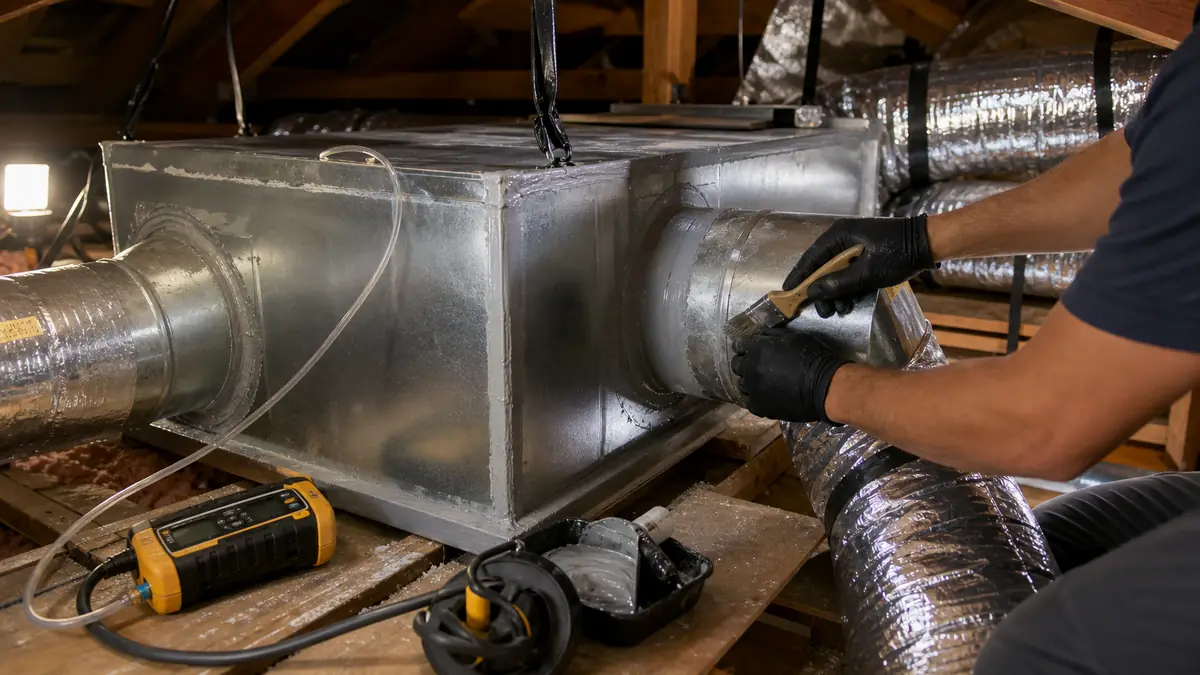
The work starts with measurement, not guesswork. We put a manometer on the system and read total external static pressure - the resistance the blower is fighting - and a high number tells us a restriction, usually a starved return, is the problem rather than the equipment. We inspect the attic runs for crushed flex, separated joints, and disconnected boots, and we trace the return path for undersizing. Then we seal: mastic and mechanical fasteners at every joint, boot, and plenum connection, never relying on cloth tape that bakes loose in a 130 F attic. Where a return is starving the blower, we add or enlarge it to drop the static pressure into spec. We re-measure static pressure and airflow at the registers to confirm the fix moved real air, and on a duct change that triggers Title-24, the third-party HERS rater field-verifies the sealing to the leakage target so the job clears inspection.
Which West Covina homes have the worst duct problems?
The pattern follows the build era. The Galaxie, Cameron Park, Merlinda, and Vincent tracts went up between the 1950s and 1970s with compact duct layouts and modest returns sized for the smaller air conditioners of that day; decades of attic heat have crushed the flex and dried the mastic, and many of these homes now carry a larger Carrier condenser the old ducts cannot feed. Newer South Hills and Woodside Village estates have a different issue - long runs to far bedrooms and vaulted ceilings that need careful balancing rather than wholesale replacement. We match the fix to the stock: sealing and right-sizing for the tracts, balancing and targeted repair for the estates.
What does duct work cost in West Covina, and why?
Sealing and balancing the existing system - closing supply leaks, reconnecting boots, and tuning the registers - runs $300-$1,500 and is the highest-return spend for a home with hot back bedrooms. Adding or resizing a starved return is $500-$1,800 and is what relieves a blower fighting high static pressure. A full duct replacement on crushed 1960s flex, with a complete reroute and sealing, lands at $1,900-$6,000 depending on the home's size and run complexity, and that change brings the HERS field-verification fee with it. The cost drivers are attic access in summer heat, the number and length of runs, and whether the job triggers Title-24 verification. We measure first and quote the specific work, because sealing a $400 leak beats replacing a $2,300 blower motor that was never the real fault.
When should ducts be replaced, not just sealed?
When the flex is crushed, mold-stained, or so undersized that sealing alone cannot move the airflow your new Carrier condenser needs, replacement is the honest call - and a HERS test usually rides along with it. We often do this alongside a new system install so the ducts and equipment are matched. For a sizing-led approach, see the Manual J and duct guide.
Common questions
Why are some rooms in my West Covina home always hot?
Uneven room temperatures almost always trace to duct problems: leaks in the attic supply runs, a disconnected boot, or undersized returns common in 1960s Galaxie and Cameron Park tracts. Sealing and balancing the ducts fixes the hot back bedroom far more reliably than turning the thermostat down, which just overworks the condenser.
Does duct sealing need HERS verification in West Covina?
Inside Climate Zone 9, Title-24 usually calls for HERS field-verified duct sealing whenever you change out or replace a sizable share of the duct system or put in a new condenser or furnace. We seal to the leakage target and book the third-party HERS rater so the work clears inspection.
Can leaky ducts trip my Carrier system's fault code?
Yes. A collapsed or leaky return restricts airflow, which can trip a furnace high-limit (code 13) or log Infinity code 44, excessive air-delivery restriction. We check static pressure and the return path before assuming the equipment itself is at fault.
How much air is a leaky West Covina duct system actually losing?
Older attic duct systems commonly lose 20 to 30 percent of conditioned air to leaks before sealing - air you paid to cool dumping into a 130 F attic. We measure leakage and static pressure rather than guess, and sealing to the Title-24 target typically returns the lost airflow to the rooms it was meant for, which is why duct sealing is often the highest-return HVAC work a tract home can get.
Will sealing my ducts make the house quieter and less dusty?
Usually yes. A leaky return pulls dusty, unconditioned attic air into the system, so sealing the return path cuts the grit reaching your registers, and relieving a starved blower lowers the rush of air noise at the grilles. The bigger comfort win is even room temperatures once the supply leaks are closed and the system is balanced.
Can you seal ducts without tearing open my ceilings?
In most West Covina tract homes the ducts run in an accessible attic, so we seal boots, joints, and the return path by hand with mastic and mechanical fasteners without opening drywall. Only a fully crushed or buried run needs replacement, and we tell you which case yours is after measuring static pressure and inspecting the attic.