Carrier Furnace Repair in West Covina
Fast answer: West Covina Carrier HVAC repairs Carrier 58 and 59-series gas furnaces across West Covina and Woodside Village (91792) - igniters, flame sensors, pressure switches, and flash codes 13, 14, 31, and 34. A diagnostic runs $95-$200 and reads the amber LED code first, so call (213) 277-6575 or book online.
Quick rundown
- Carrier furnace repair across 91790, 91791, 91792, 91793.
- Units serviced: 59MN7/59TN/59SC condensing and 58TN/58SC 80% Ultra-Low NOx furnaces.
- Common parts: hot-surface igniter, flame sensor, inducer, pressure switch, limit and rollout switches, gas valve, control board.
- We read the two-digit flash code (count short flashes then long) before quoting.
- Typical repair range: $95 to $2,000; safety issues like a cracked heat exchanger get a candid replace recommendation.
- In-warranty Carrier furnaces referred to a factory-authorized dealer first.
- Independent shop.
How do Carrier furnace flash codes work?
Carrier furnaces report faults through an amber status LED: count the short flashes for the first digit and the long flashes for the second, so three short plus four long reads as 34. Infinity communicating furnaces also show the number and a plain-language description on the touchscreen. The codes we see most in West Covina are 13 (limit lockout from overheating), 14 (ignition lockout), 31 (pressure switch), 33 (limit fault), and 34 (ignition proving). Reading the code first means we are not guessing - a furnace that throws 34 almost never needs a board, just a flame sensor.
| Symptom (code) | Likely cause / first check | Cost lane |
|---|---|---|
| No ignition, hard lockout (code 14) | Failed hot-surface igniter or no gas / closed valve | $150 - $650 |
| Lights then drops out (code 34) | Dirty/weak flame sensor or low gas pressure | $95 - $350 |
| Short-cycles, overheats (code 13/33) | Low airflow: clogged filter, return, or blower wheel | $95 - $500 |
| Inducer runs, no ignition (code 31) | Pressure switch stuck or blocked flue / inducer | $200 - $600 |
| Rollout trip (code 26) | Possible cracked or overheated heat exchanger - safety | $300 - $2,000 |
| Control fuse blown (code 24) | Shorted low-voltage wiring or failed component | $120 - $400 |
How does a Carrier furnace repair actually go?
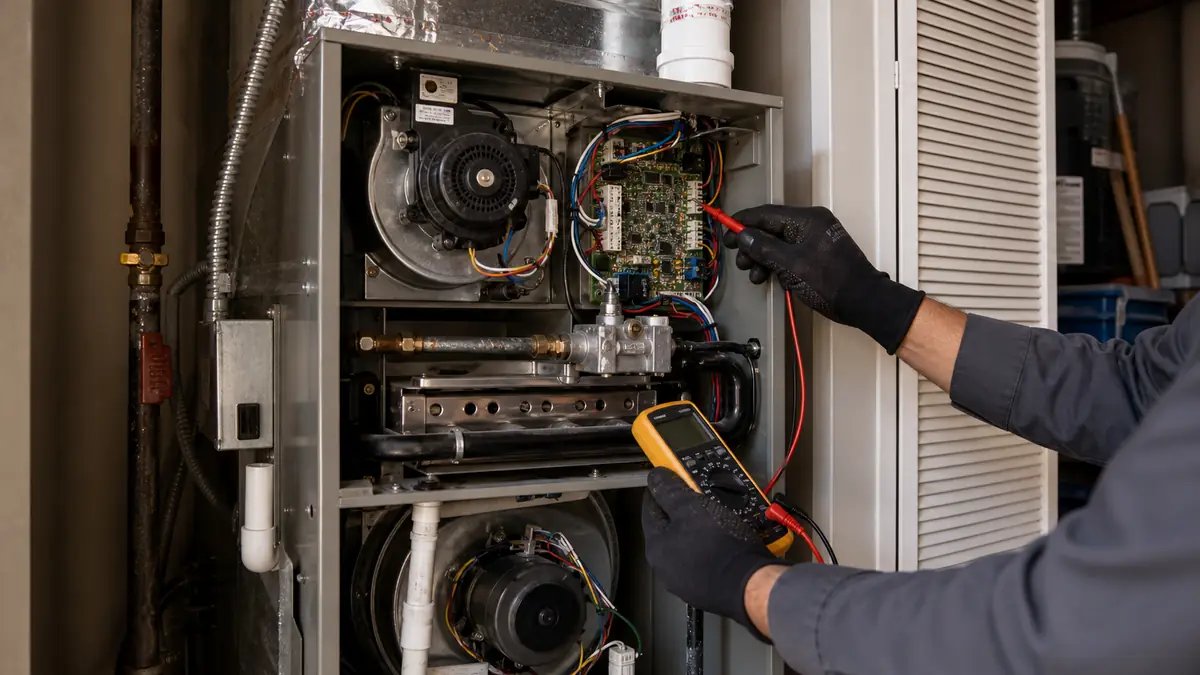
We work the ignition train in the order the furnace itself follows. After reading the stored flash code at the control board, we put a call for heat in and watch the sequence: the inducer motor should spin up and close the pressure switch, the hot-surface igniter should glow, the gas valve should open, and the flame sensor should prove flame within a few seconds. Each stage points at a part. A no-glow igniter on a code 14 lockout is a cracked or open hot-surface igniter. A glow-then-dropout on code 34 is almost always a dirty flame sensor - we pull it, clean the rod with a fine abrasive, and re-test before we ever quote a board. A code 31 sends us to the inducer draw and the flue. A code 13 or 33 sends us to airflow: filter, return, and blower wheel. We meter the gas valve, the limit and rollout switches, and the 24V control circuit (a blown control fuse is code 24), then replace the proven-bad part and cycle the furnace through a full ignition to confirm the code clears.
Which Carrier furnaces do you service?
We repair the 58 and 59-series across the lineup. The 59-series are the condensing, higher-AFUE furnaces: the modulating 59MN7 (Infinity 98) with a variable-speed ECM blower, the two-stage 59TN6/59TN7 (Infinity 96/97), the Ultra-Low NOx 59CU5 (Infinity 95), and the Performance and Comfort condensing units (59TP6, 59SC6). The 58-series are the 80 percent furnaces - 58TN, 58TP, 58SC and their Ultra-Low NOx variants - which are common and frequently adequate in mild Zone 9 where the furnace barely runs. The repair approach shifts with the tier: an 80 percent single-stage unit is mostly igniter, flame sensor, and pressure switch, while a modulating 59MN7 or a communicating Infinity furnace adds the variable-speed ECM module and the touchscreen diagnostics, where a fault shows as both a number and plain language. Telling us the model off the cabinet label lets us bring the right igniter and sensor on the first trip.
What does a furnace repair cost in West Covina?
The common fixes are inexpensive. A flame-sensor clean or replace on a code 34 runs $95-$350, and it resolves a large share of no-heat-after-ignition calls. A hot-surface igniter on a code 14 lockout is $150-$650. A pressure-switch or inducer fault (code 31) lands at $200-$600. An airflow-driven limit trip (code 13/33) is often just a filter, return, or blower-wheel cleaning at $95-$500. The diagnostic itself is $95-$200 and is frequently credited toward the repair. The expensive outcome is a safety finding: a rollout trip (code 26) can indicate a cracked or overheated heat exchanger, a carbon-monoxide concern that runs $300-$2,000 to address - and on an older 58-series furnace, replacing the whole unit is usually both safer and cheaper than the exchanger alone. We give you the repair number and, when a crack is confirmed, a candid replacement number beside it.
Why does low airflow cause so many furnace faults?
West Covina's 1960s tract homes were built with undersized returns and tight duct runs, and decades of dust plus a neglected filter choke the blower. When airflow drops, the heat exchanger overheats and the high-limit switch trips - that is your code 13 or 33. We check the filter, the return sizing, and the blower wheel before replacing a limit switch, because swapping the switch without fixing airflow just buys a week. If your home has chronic airflow trouble, our duct repair and sealing page covers the fix.
When is a cracked heat exchanger a replace decision?
A rollout trip (code 26) can point to a cracked or overheated heat exchanger, which is a carbon-monoxide safety matter. Once we verify a crack on an older 58-series furnace, swapping the whole furnace is generally both safer and cheaper than the exchanger by itself, and it is frequently the right moment to weigh a heat-pump conversion that covers both seasons. The repair-or-replace guide walks the full decision.
Common questions
What does flash code 34 mean on my Carrier furnace?
Code 34 is an ignition proving failure - the furnace lit but lost the flame signal, usually a dirty or weak flame sensor, low gas pressure, or a grounding issue. We clean and test the flame sensor first; it is a cheap fix that solves most code-34 callouts in West Covina homes before any board replacement.
My Carrier furnace short-cycles and shows code 13 or 33. Why?
Both point to the limit circuit. Code 13 is a hard limit lockout and 33 is a limit-circuit fault - both mean the furnace is overheating, almost always from low airflow: a clogged filter, a collapsed return, or a dirty blower wheel in those undersized Galaxie and Vincent tract systems. We restore airflow before condemning the limit switch.
Do I really need a furnace in West Covina's mild winters?
Many West Covina homes run an 80 percent 58-series furnace and barely use it - Zone 9 winters are mild. If your furnace is failing, that is a good moment to weigh a gas-to-heat-pump conversion, since one system would then cover both heating and the heavy summer cooling load.
What does code 31 mean on a Carrier furnace?
Code 31 means the pressure switch did not close or reopened during the call - the inducer motor is weak, the flue is blocked, or the switch or its tubing has failed. We confirm the inducer draws properly and the flue is clear before replacing the switch, because a blocked vent is a combustion-safety issue, not just a nuisance fault.
Is an Ultra-Low NOx furnace required in West Covina?
South Coast air-district rules push Ultra-Low NOx equipment across the Los Angeles basin, and Carrier sells Ultra-Low NOx versions across the 58 and 59 lines (for example the 59CU5 Infinity 95) to meet them. When a failing furnace needs replacing, we spec a compliant model rather than an older standard-NOx unit that would not pass.
Why does my furnace smell like burning dust when it first runs?
A faint burning-dust smell on the first cold-morning startup of the season is normal - dust that settled on the heat exchanger over a hot West Covina summer is burning off, and it clears in an hour or two. A persistent, sharp, or electrical smell is different and warrants a shutdown and a service call to check the blower, wiring, and heat exchanger.